
North Carolina NCDMV Permit Practice Test 4
Test 4 of 10. Pick an answer for each question to see if it is right and why; your score appears at the end. You need 20 correct answers to pass, the same ratio as the real North Carolina test.

- Questions25
- Correct to pass20
- Passing score80%
- Minimum age15 years
-
1. Unless otherwise posted, what is the maximum speed limit outside North Carolina cities and towns?
Show answer
Answer D: 55 mph
North Carolina's table of maximum speed limits sets 55 mph outside cities and towns, against 35 mph inside them and 70 mph on interstates.
-
2. For how long is a North Carolina Form DL-123, binder or insurance certificate valid as proof for a driver license?
Show answer
Answer D: 30 days from the date of issuance
North Carolina accepts Form DL-123, binders and certificates as proof of liability insurance for only 30 days from the date of issuance.
-
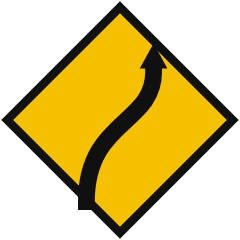
3. A driver holds a steady highway speed into the section this sign warns about. What is the most likely result?
Show answer
Answer B: The vehicle runs wide toward the outside and can cross into another lane or leave the pavement
Holding speed into a change of alignment asks the tires for more side grip than they can supply, so the vehicle runs wide and the driver is left with less room to correct.
-
4. Children are playing close to the edge of a residential street. What is the right speed choice?
Show answer
Answer D: Well below the limit, slow enough to stop for a sudden dash
Children can step out without warning, so the safe speed is the one that lets you stop within the distance you can see to be clear.
-
5. Where should you be looking as you back into a parallel parking space?
Show answer
Answer B: Over your shoulder through the rear window, glancing all around
Mirrors and cameras leave blind areas, so turn and look through the rear window while checking the front of your car and both sides as it swings.
-
6. At a rural intersection a beacon flashes yellow toward the main road and red toward the side road. How is each approach treated?
Show answer
Answer A: The main road slows and proceeds, the side road stops
An intersection control beacon assigns flashing yellow to the road with priority and flashing red to the approach that must stop and yield.
-
7. Under North Carolina's Lose Control, Lose Your License provision, what costs a student the driving privilege?
Show answer
Answer A: A disciplinary suspension or alternative placement of more than 10 consecutive days
North Carolina takes the driving privilege when a student is suspended, or assigned to an alternative educational setting for discipline, for more than 10 consecutive days, and the loss runs 12 months or until a Driving Eligibility Certificate is obtained.
-
8. What happens to your field of vision as your speed increases?
Show answer
Answer C: It narrows, so you notice less at the sides of the road
The faster you travel, the more your useful field of view narrows toward the center, so a hazard coming from the side is seen late or missed altogether.
-
9. The trailer you are towing begins to sway from side to side at highway speed. What should you do?
Show answer
Answer D: Ease off the accelerator, hold the wheel steady and let the speed drop
Sway grows with speed and with sudden inputs. Reducing speed gently while keeping the steering steady lets the trailer settle behind you.
-
10. A North Carolina driver turning right on red fails to yield to a pedestrian crossing in front of the stopped traffic. What penalty applies?
Show answer
Answer C: Not less than $100 and not more than $500
North Carolina sets a penalty of not less than $100 and not more than $500 for failing to yield to such a pedestrian when turning right on a red signal.
-
11. A barricade carries a sign reading ROAD CLOSED TO THROUGH TRAFFIC. What does it permit?
Show answer
Answer B: Local access for people whose destination is on that road
This closure keeps out drivers who are only passing through while still allowing residents and deliveries to reach addresses within the closed section.
-
12. Why is repeatedly changing lanes to work through heavy traffic a poor idea?
Show answer
Answer A: It raises the crash risk and saves almost no time
Each lane change adds a conflict with another vehicle, and in congestion the lanes move at similar average speeds, so the gain is negligible.
-
13. How may a North Carolina vehicle owner meet the financial responsibility requirement without an insurance policy?
Show answer
Answer B: By a certificate of self-insurance for a fleet of 25 or more vehicles
North Carolina accepts a liability policy, cash or a bond deposited with the State Treasurer, or a certificate of self-insurance for fleets of 25 or more vehicles.
-
14. Besides motorist services and tourist information, a blue sign background is also used for
Show answer
Answer B: evacuation route signing
Blue is assigned to road user services, tourist information and evacuation routes, so hurricane and other evacuation routes are signed in blue.
-
15. A North Carolina driver has been stopped by a law enforcement officer and the phone rings. What does NCDMV advise?
Show answer
Answer C: Wait for the officer to say whether the call may be answered
The North Carolina Driver Handbook tells drivers not to talk on a cell phone while interacting with an officer during a stop, and states that the officer will say whether an incoming call may be answered.
-
16. What is the minimum light transmittance allowed for after-factory window tint in North Carolina?
Show answer
Answer A: 35 percent
North Carolina allows tinted windows with a light transmittance of no less than 35 percent, and after-factory tint adds a $10 charge to the vehicle inspection.
-
17. A North Carolina 16-year-old received a Driving Eligibility Certificate on hardship grounds. How does that affect graduated licensing?
Show answer
Answer D: It does not change it, so every graduated step must still be completed
North Carolina does not issue a hardship driving permit or license, and the graduated licensing steps must still be followed when a Driving Eligibility Certificate is granted for hardship.
-
18. What belongs in a basic emergency kit carried in a car?
Show answer
Answer D: A flashlight, a first aid kit, jumper cables and some warning devices
A useful kit lets you see, be seen, treat an injury and restart the vehicle; carrying loose gasoline is a fire risk.
-
19. A North Carolina driver under 18 is convicted of a second moving violation within a 12-month period. How long may the license be suspended?
Show answer
Answer B: 30 days
North Carolina suspends a provisional licensee for 30 days on a second moving violation within 12 months, for 90 days on a third and for six months on a fourth.
-
20. What is the benefit of looking far down the road rather than just ahead of the hood?
Show answer
Answer A: You steer with smaller corrections and you see trouble in plenty of time
A distant view steadies your steering and gives you time to plan, because you meet hazards after you have already seen them.
-
21. You are following another vehicle down a long, steep grade. What should you do about the gap?
Show answer
Answer D: Make it longer, because both of you need more room to stop
Everything takes longer to stop on a downgrade, including the vehicle ahead, so the gap that works on the flat is no longer enough.
-
22. A North Carolina vehicle has an active passenger-side front air bag and a rear seat. Which child must ride in the rear?
Show answer
Answer A: A child under age 5 who weighs less than 40 pounds
North Carolina requires a child under age 5 and weighing less than 40 pounds to ride in the rear seat where the vehicle has an active passenger-side front air bag and a rear seat, unless the restraint is designed for use with a front air bag.
-
23. A flagger in a work zone turns a paddle so that the red octagonal face reading STOP is toward you. What must you do?
Show answer
Answer A: Stop completely and wait for the flagger to signal you forward
The STOP face of a flagger paddle requires a complete stop, and you may move again only when the flagger directs you to.
-
24. Which stopped vehicle triggers North Carolina's Move Over duty?
Show answer
Answer C: A public service vehicle helping a disabled vehicle, warning lights on
North Carolina's Move Over law covers authorized emergency vehicles and public service vehicles being used to assist motorists or law enforcement with wrecked or disabled vehicles, parked within 12 feet of the roadway with warning lights activated.
-
25. You have parked but your car sits across the line into the next space. What should you do?
Show answer
Answer B: Pull out and park again fully inside one space
A car over the line takes a space away from someone else and leaves too little room for the doors of the vehicles beside it.