
North Carolina NCDMV Permit Practice Test 20
- Questions25
- Correct to pass20
- Passing score80%
- Minimum age15 years
-
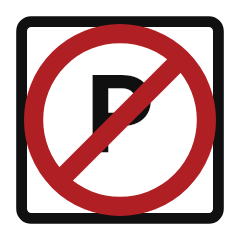
1. A driver leaves the vehicle at the curb where this sign is posted and walks away for two minutes. Is that allowed?
Show answer
Answer B: No, leaving the vehicle unattended there is prohibited whatever the length of the absence
Walking away leaves the vehicle parked, and the prohibition holds regardless of how long the driver is gone or whether the engine is left running.
-
2. A driver who is passing you cannot complete the pass because a vehicle is coming. What should you do?
Show answer
Answer C: Ease off the accelerator and make room for them to drop back in
The only place for the passing vehicle to go is the gap behind you, and easing off opens that gap immediately.
-
3. A city transit bus at a stop ahead of you switches on its left signal. What should you do?
Show answer
Answer D: Slow and let the bus pull back into traffic
A bus needs a long gap to rejoin traffic, and yielding to a signaling transit bus keeps the whole line of traffic moving safely.
-
4. Your vehicle is burning at the roadside. How far away should everyone keep?
Show answer
Answer D: At least a hundred feet away from the vehicle and upwind, out of the drifting smoke
Burning vehicles give off toxic smoke and parts such as tires and struts can burst, so keep a long distance and stay upwind.
-
5. Why is it dangerous to make a left turn from the second lane from the center?
Show answer
Answer C: Because a driver in the lane beside you is turning into the same space
Drivers in the proper turn lane are entitled to that space, and turning across them puts two vehicles into one path through the intersection.
-
6. What does a blood alcohol concentration of 0.08 mean for the driver of a car?
Show answer
Answer B: It is the level almost every state treats as legally intoxicated
In almost every state a driver at 0.08 or above is legally intoxicated whatever the driver seems like, but impairment starts well before that level is reached.
-
7. How early may a North Carolina vehicle be inspected before its registration expires?
Show answer
Answer A: Up to 90 days before
North Carolina requires an annual safety or safety and emissions inspection, and the inspection may be performed up to 90 days before the registration expiration date.
-
8. You have a green arrow to turn left. What still applies?
Show answer
Answer D: You must yield to any pedestrian or vehicle still inside the intersection
A green arrow protects your turn from conflicting traffic, but you must still let anyone already in the intersection get clear before you move.
-
9. Your light turns green and a driver on the cross street enters against a red. What should you do?
Show answer
Answer D: Hold back and let that vehicle go through
Giving up a right of way you are entitled to is the only way to avoid a crash with a driver who has already failed to yield.
-
10. You hear a bang and one of the front tires deflates while you are on the highway. What happens to the vehicle?
Show answer
Answer D: It pulls strongly toward the side that failed
The collapsed tire drags heavily on that corner, so the vehicle veers toward it. Hold the wheel firmly, keep your line and let the speed fall before leaving the road.
-
11. A rectangular red sign with the white words WRONG WAY means that
Show answer
Answer C: the driver is already traveling against the legal flow and must not continue
The wrong way sign uses a white legend and border on red and addresses a driver who has entered a ramp or one-way roadway in the wrong direction, who should stop and turn around safely.
-
12. Which sign shape is reserved for one message only, the requirement to stop?
Show answer
Answer A: The octagon
The octagon is used for the stop sign and for no other message, so the outline alone identifies the requirement even when the legend is hard to read.
-
13. Two left-turn lanes are available and you must turn right again a short distance after the turn. Which of the two should you use?
Show answer
Answer D: The right one, so you finish nearer the right side of the new street
Each turn lane feeds the matching lane of the new street, so choosing the right-hand of the two left-turn lanes leaves you closer to the side you will need.
-
14. You see a shield for a three-digit Interstate whose first digit is even. What does that tell you about the route?
Show answer
Answer C: It loops around a city and rejoins its parent route
A three-digit Interstate beginning with an even digit is a loop or beltway that connects back to the main route at both ends, while an odd first digit marks a spur.
-
15. The left-turn signal facing you shows a flashing yellow arrow. What does it mean?
Show answer
Answer C: You may turn left after yielding to oncoming traffic and to pedestrians
A flashing yellow arrow permits a left turn but gives no protection, so you must yield to oncoming vehicles and to people in the crosswalk.
-
16. While you are still on an entrance ramp, where should your attention be?
Show answer
Answer D: Along the ramp ahead and back at the highway traffic in the mirrors and over your shoulder
A merge needs both halves of the picture at once: the ramp curving ahead of you and the traffic you are about to join behind and to your left.
-
17. Another driver takes a right of way that was legally yours. What should you do?
Show answer
Answer A: Give way to the other driver and avoid the crash, whatever the law says
Right of way is something you give, not something you take, and being in the right is no protection in a collision.
-
18. You are waiting to turn left at a solid green light with no green arrow. Oncoming traffic is approaching. What should you do?
Show answer
Answer A: Yield to the oncoming traffic and turn only when there is a safe gap
A solid green light permits the left turn but does not protect it, so you must yield to oncoming vehicles and to pedestrians before turning.
-
19. Traffic in your lane is backed up and the paved shoulder looks clear. May you drive along it to get past?
Show answer
Answer C: No, the shoulder is not a travel lane
Passing must be done within the roadway; driving on the shoulder to get around traffic is prohibited and surprises anyone entering from the right.
-
20. You are turning left at an intersection just beyond the crest of a hill. What is the added risk?
Show answer
Answer B: Oncoming vehicles appear with very little warning and close quickly
A crest hides approaching traffic until it is close, so the gap you thought was empty can fill in the time the turn takes.
-
21. What does North Carolina law require of the owner of a registered vehicle in the matter of insurance?
Show answer
Answer C: Continuous liability coverage while the vehicle has a valid plate
North Carolina requires continuous liability insurance for as long as the vehicle carries a valid license plate, and the state does not honor any grace period between policies.
-
22. You stop at a rest area because you are sleepy. How long a nap is usually recommended?
Show answer
Answer D: About fifteen to twenty minutes
A short nap of fifteen to twenty minutes restores useful alertness without leaving the grogginess a longer sleep can bring, and you should wait a few minutes before driving on.
-
23. At highway speed, a large object suddenly appears in your lane and there is open space beside you. Which response is often the most effective?
Show answer
Answer B: Steer around it, since at speed you can often turn quicker than you can stop
Above roughly 25 mph, stopping distance is long while a lane change takes only a moment. When space is available, a controlled steer around the hazard avoids the impact.
-
24. A strong wind is blowing across an open stretch of road. Besides the gusts, what else should you watch for?
Show answer
Answer A: Branches, dust and loose objects blown into your path
High wind strips branches, litter and dust onto the roadway and can push other vehicles out of their lane, so scan much further ahead than usual.
-
25. You are leaving a freeway on an exit ramp posted with an advisory speed of 25 mph. Where should you slow to that speed?
Show answer
Answer A: In the deceleration lane, before you reach the curve of the ramp
Slowing belongs in the deceleration lane so you arrive at the curve already at the advisory speed and do not hold up traffic still in the through lanes.