
North Carolina NCDMV Permit Practice Test 19
- Questions25
- Correct to pass20
- Passing score80%
- Minimum age15 years
-
1. Who must wear a seat belt in a North Carolina vehicle that was manufactured with belts?
Show answer
Answer C: The driver and all passengers whenever the vehicle moves forward
North Carolina requires the driver and all passengers in a vehicle manufactured with seat belts to be properly belted at all times when the vehicle is in forward motion on a street or highway.
-
2. On dry pavement in good weather, what is the smallest following gap you should keep?
Show answer
Answer A: About three seconds behind the vehicle ahead
Three seconds is the accepted minimum on dry roads in good visibility, and the gap should be longer in poor conditions.
-
3. In a work zone one lane sits an inch or two lower than the lane beside it. How should you change lanes?
Show answer
Answer C: Slow down and cross the edge at a shallow angle, holding the wheel firmly
A vertical edge between lanes can catch a tire and jerk the steering. Crossing slowly at a shallow angle lets the wheel climb without grabbing.
-
4. The road ahead is broken up with potholes and rough patches. What should you do?
Show answer
Answer C: Slow down, since a hole hit at speed can wreck a tire or wheel
A lower speed cuts the impact on tires, wheels and suspension and gives you time to choose a line through the rough surface.
-
5. You reach a T intersection where the cross street has a ONE WAY sign pointing to the right. What may you do?
Show answer
Answer B: Turn right only, because the street carries traffic in that direction
The arrow shows the only direction traffic may travel, so the only legal movement from the terminating road is a right turn.
-
6. Where is the no passing zone pennant sign installed?
Show answer
Answer A: On the left side of the roadway
The pennant is placed on the left side of the roadway at the beginning of the no-passing zone, in the field of view of a driver who is thinking about overtaking.
-
7. You are overtaking in a short passing lane on a two-lane road and it is about to end. What must you do?
Show answer
Answer A: Finish the pass and move back to the right before it ends
The added lane ends and the traffic returns to a single lane in each direction, so the pass has to be complete before the pavement runs out.
-
8. A sign at the approach to a bridge reads WEIGHT LIMIT 10 TONS. What does the figure set?
Show answer
Answer B: The heaviest vehicle the bridge may legally carry
A weight limit sign is a regulation based on what the structure can bear, and it applies to the loaded weight of the whole vehicle.
-
9. Which North Carolina conviction brings a 0.00 alcohol concentration restriction on restoration?
Show answer
Answer C: DWI committed in a commercial motor vehicle
North Carolina applies a 0.00 alcohol concentration restriction after a DWI in a commercial motor vehicle, after driving following the consumption of alcohol or drugs while under 21, and after felony death by vehicle.
-
10. A hot drink tips over onto your lap while you are driving. What should you do?
Show answer
Answer A: Keep hold of the wheel and stop when it is safe
The spill is painful but the crash risk comes from letting go of the wheel or braking suddenly, so keep control and deal with it once you are stopped.
-
11. Why are sign shapes and colors standardized across the whole country?
Show answer
Answer D: So a driver knows the kind of message before reading it
Uniform shapes and colors let a driver classify a sign as regulatory, warning or guide from a distance, before the legend can be read.
-
12. A deer suddenly steps onto the road ahead of you at night. What is the safest response?
Show answer
Answer C: Brake firmly and stay in your lane rather than swerving
Swerving at speed often leads to a rollover or a head-on crash that is far worse than hitting the animal. Brake hard, hold your lane and expect more deer to follow.
-
13. Why should cruise control be switched off on wet, snowy or icy roads?
Show answer
Answer B: It may keep feeding power to a wheel that has started to slip, and cancelling it costs you time
Cruise control holds a set speed regardless of grip, so it can add power just as a tire loses traction, and the extra step of cancelling it delays your response.
-
14. The lights at a highway-rail grade crossing begin to flash red as you approach. What must you do?
Show answer
Answer B: Stop short of the tracks and wait until the lights stop and no train is near
Flashing red lights at a crossing require a stop clear of the tracks, and you may proceed only once the lights have stopped, any gates are fully raised and no train is approaching.
-
15. From which lane should a permitted U-turn be started?
Show answer
Answer A: The lane nearest the center line, the same one used for a left turn
A U-turn is begun from the far left lane for your direction, the same position used for a left turn, so you do not cut across traffic beside you.
-
16. A sign beside the signal reads STOP HERE ON RED. What does it tell you?
Show answer
Answer B: Stop at that point on red, not closer to the intersection
The sign marks the required stopping point, which is set back from the corner so that turning vehicles and sight lines are not blocked.
-
17. In plain words, what is understeer?
Show answer
Answer B: The vehicle keeps going straight even though the wheels are turned
Understeer means the front tires have run out of grip, so the vehicle takes a wider line than the one you steered.
-
18. Why is dusk one of the harder times of day to drive?
Show answer
Answer B: The failing light blurs shapes into the background
In fading light there is not enough contrast to pick objects out, yet it is not dark enough for headlights to do the work, so pedestrians and cyclists disappear.
-
19. You are stopped in traffic at a red light when an ambulance comes up behind you with its siren on. What is the correct action?
Show answer
Answer D: Stay put until you can move aside legally and safely
You must not run a red light or make an unsafe move to yield; wait, then pull to the side once the way ahead lets you do it safely.
-
20. At an intersection that uses a lagging left turn, when is the left-turn arrow displayed?
Show answer
Answer B: After the through movement has run
A lagging left turn phase runs at the end of the green rather than the start, so a driver waiting to turn should not assume the arrow has been missed.
-
21. A wide solid white line separates the through lanes from an exit lane. What does it tell drivers?
Show answer
Answer B: The choice of lane should already have been made
A channelizing line marks where the paths separate and crossing it is discouraged or prohibited, so the lane change has to happen upstream.
-
22. You make eye contact with a driver waiting to pull out of a side street. What should you assume?
Show answer
Answer D: The driver may still not have seen you, so stay ready to slow or stop
Drivers can look directly at you and still not register your vehicle, especially a small one. Eye contact helps, but never rely on it.
-
23. You have signaled and pulled up level with the car in front of an empty curb space. What comes next?
Show answer
Answer A: Reverse slowly while turning the wheel toward the curb
From alongside the forward car you back in on a turn toward the curb, then straighten and swing the front in as the rear reaches the space.
-
24. You are about to open your door after parking on the traffic side of the street. What should you do first?
Show answer
Answer C: Check the mirror and look back for approaching vehicles and bicyclists before opening the door
A door opened into traffic can strike a passing bicyclist or vehicle, so you check behind you first and keep the door open no longer than necessary.
-
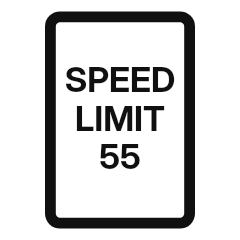
25. A driver passes this sign on an open road. Over what stretch does the figure it sets stay in force?
Show answer
Answer A: From the sign onward, in every lane, until another sign sets a different figure
The figure governs the road from the sign onward and binds every lane, and it stays in force until a later sign sets a different one.