
North Carolina NCDMV Motorcycle Practice Test 50
- Questions25
- Correct to pass20
- Passing score80%
- Minimum age16 years
-
1. You have passed a large truck and want to move back into its lane. What should you see first?
Show answer
Answer B: Both of its headlights in your rear-view mirror
Seeing both headlights in your mirror means you are far enough ahead to be out of the truck's front no-zone before you move over.
-
2. A North Carolina driver is convicted of DWI and has a prior offense that occurred within three years. What revocation applies?
Show answer
Answer C: Four years
North Carolina mandates a four-year revocation on a second DWI conviction when the prior offense occurred within three years of the current one.
-
3. How does a NO OUTLET sign differ from a DEAD END sign?
Show answer
Answer B: It warns that a whole group of streets has no way out
No Outlet is posted where the road leads into a network of streets from which there is no through route, while Dead End refers to the single street itself.
-
4. A center lane is bordered by a solid yellow line on the outside and a broken yellow line on the inside, with left-turn arrows painted in it. How may you use that lane?
Show answer
Answer A: Only to make a left turn or to prepare for one from either direction
That marking identifies a two-way left turn lane, which may only be used for left turns or to prepare for a left turn and never for travel or passing.
-
5. Two drivers each have three drinks, one over three hours and one in half an hour. What is the difference?
Show answer
Answer C: The fast drinker reaches a higher peak level
The liver removes alcohol at a steady rate, so drinking faster than the body can clear it pushes the blood alcohol level much higher.
-
6. You are traveling at 55 mph and see a vehicle ahead moving at about 15 mph. What is the hazard?
Show answer
Answer A: You reach it far sooner than you expect
At a 40 mph difference you cover the gap in a few seconds, which is why drivers strike slow vehicles they saw in plenty of time.
-
7. How many usable riding paths does a single traffic lane offer a motorcycle?
Show answer
Answer C: Three
A lane is normally treated as a left, center and right path, and the rider picks the one that gives the best visibility and the largest space cushion.
-
8. You are starting from a stop on a snowy, icy street and the drive wheels begin to spin. What should you do?
Show answer
Answer C: Ease off the accelerator and start again more gently
Spinning tires polish the surface and dig in. Very gentle pressure on the accelerator, and a higher gear if you have one, gives the tires the best chance to grip.
-
9. Your light turns green while a pedestrian who started on the walk signal is still crossing in front of you. What must you do?
Show answer
Answer D: Let them finish crossing the road before you move off on your green light
A pedestrian who entered the crosswalk lawfully keeps the right of way until they reach the other side, whatever the signal now shows.
-
10. How does braking distance change if you double your speed?
Show answer
Answer D: It grows much more than twice as long
Braking distance increases with the square of speed, so doubling speed roughly quadruples the distance needed to stop.
-
11. Why does a passenger often feel the cold sooner than the rider on a long ride?
Show answer
Answer B: A passenger sits still and does not have the fuel tank to shelter behind
The rider has a screen or a tank to break the wind and is busy operating the machine, while a passenger sits exposed and inactive and chills faster.
-
12. Which surfaces usually offer less grip than the pavement around them when wet?
Show answer
Answer B: Painted markings, metal plates and bridge decks
Paint, steel and bridge decks all shed grip when wet or cold, so brake before you reach them rather than on top of them.
-
13. When may a driver of a motor vehicle use a marked bicycle lane?
Show answer
Answer C: Only to cross it when turning or entering the road where the markings allow
A bike lane is a lane for cyclists. Motor vehicles may only cross it to enter or leave the road or to make a turn where the markings permit.
-
14. During the tire check you find a nail driven into the rear tire. What should you do?
Show answer
Answer D: Have the tire repaired or replaced before the motorcycle is ridden
A punctured motorcycle tire can lose air suddenly, and a motorcycle has no second tire on that end to hold the machine up.
-
15. Your loaded vehicle weighs more than the figure shown on a posted weight limit sign. What must you do?
Show answer
Answer D: Find another route, because crossing is not permitted
A posted weight limit is a legal maximum, not advice, so an overweight vehicle has to take a different route.
-
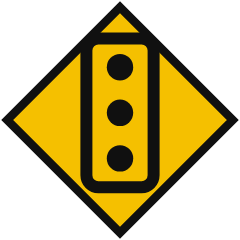
16. What does this sign require of the driver?
Show answer
Answer D: Reducing speed and being ready to stop at the intersection ahead
The advance notice asks the driver to slow and be ready to stop, while whether a stop is actually needed depends on the indication displayed on arrival.
-
17. You have dropped some distance behind the rest of your group. What should you do?
Show answer
Answer C: Keep your own safe pace, because the group should slow to bring you back
Chasing the group means riding beyond a comfortable pace, so the responsibility sits with the leader to slow down until the formation is whole again.
-
18. Besides the motorcycle knowledge test, how may a North Carolina rider satisfy the skills requirement for a full endorsement?
Show answer
Answer B: By completing an approved Motorcycle Safety Foundation Basic Rider Course instead of the DMV skills test
NCDMV accepts an approved Motorcycle Safety Foundation Basic Rider Course, a valid out-of-state endorsement or accepted military motorcycle training as an alternative to its own skills test.
-
19. You are passing a crash on the other side of a divided highway. What should you do?
Show answer
Answer D: Keep your eyes on your own lane and the traffic around you
Staring at a crash scene, often called rubbernecking, causes sudden slowing and secondary collisions. Your attention belongs on the traffic in front of you.
-
20. Why is passing another vehicle a bad idea in dense fog?
Show answer
Answer C: You cannot see far enough ahead to know the passing lane is clear
A pass needs a clear view of the road well beyond the vehicle you are overtaking, and fog takes exactly that away.
-
21. Why should two riders never travel side by side in the same lane?
Show answer
Answer B: Because neither rider has room to swerve if a hazard appears
Riding directly alongside another motorcycle removes the escape path each rider needs to avoid a hazard, a pothole or another vehicle.
-
22. Why can a mild afternoon still chill a rider dangerously on the highway?
Show answer
Answer B: Riding speed creates a wind chill well below the air temperature
Air moving over the body at highway speed strips heat far faster than still air, so a comfortable temperature at a standstill can cause serious chilling in an hour of riding.
-
23. Which combination best reduces the chance of hydroplaning?
Show answer
Answer D: Good tread depth, correct tire pressure and lower speed in the rain
Tread channels water away, correct pressure keeps the tire's shape, and lower speed gives the tire time to push water aside. Hydroplaning can begin at surprisingly modest speeds.
-
24. How often should a rider change position within the lane?
Show answer
Answer C: As often as the traffic, the road surface and the hazards around you change
Lane position is a tool for keeping space and visibility, and both of those change constantly as traffic and road conditions change.
-
25. A car in the lane to your left keeps drifting toward the line between you. Which portion of your lane should you move to?
Show answer
Answer A: The right portion
Moving to the far side of your lane buys distance and time if that driver keeps coming, and it may also make the motorcycle visible to a driver who had not noticed it.