
North Carolina NCDMV Motorcycle Practice Test 19
- Questions25
- Correct to pass20
- Passing score80%
- Minimum age16 years
-
1. About how far ahead do low beam headlights let you see on a dark road?
Show answer
Answer B: About 250 feet
Low beams light roughly 250 feet of road, and high beams roughly 350 to 500 feet, which sets the limit on a safe night speed.
-
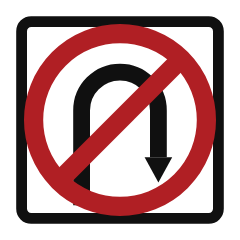
2. Why is this restriction used so often on a divided road just before a crest or a bend?
Show answer
Answer A: Because a vehicle turning across the median there stays hidden from approaching drivers until it is too late
The maneuver needs a long gap and good visibility, and where sight distance is short an approaching driver has no time to react to a vehicle turning across the road.
-
3. Which sign shape is reserved for one message only, the requirement to stop?
Show answer
Answer A: The octagon
The octagon is used for the stop sign and for no other message, so the outline alone identifies the requirement even when the legend is hard to read.
-
4. Why does even a small reduction in speed matter so much where people are walking?
Show answer
Answer D: Because a pedestrian struck at a lower speed is far more likely to survive
The chance that a pedestrian survives falls steeply as impact speed rises, so a few miles per hour can decide the outcome.
-
5. You are traveling at the same speed as a vehicle in the next lane, just behind its rear door. What should you do?
Show answer
Answer B: Change your speed so that you leave that driver's blind spot
That position is the classic blind spot. Slow slightly or move ahead so the other driver can see you before deciding to change lanes.
-
6. Why should a load never be fastened to the handlebars or the front forks?
Show answer
Answer D: The weight upsets the steering and makes the front end handle unpredictably
Anything hung on the steering moves with it and changes how the motorcycle turns, which is why loads belong low and behind the rider instead.
-
7. An oncoming driver flashes their headlights while you are waiting to turn left. What should you do?
Show answer
Answer D: Judge the situation yourself, since the flash may mean something else
A flash is not a legal signal and may mean many things, so the decision to turn stays yours and must be based on what you can see.
-
8. A minor drop has left the clutch lever bent, although it still works. What should be done?
Show answer
Answer B: Have the lever replaced before the motorcycle is ridden again
A bent lever has already been weakened and can break off in use, leaving the rider without that control at the worst possible moment.
-
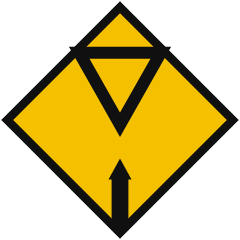
9. What will the driver have to do at the point this sign refers to?
Show answer
Answer C: Slow down and let conflicting traffic go first, stopping if that is what it takes
Further along, the driver has to let conflicting traffic and pedestrians go first, reducing speed and stopping whenever that is necessary to avoid interfering with them.
-
10. In near freezing weather, which part of an otherwise clear road is most likely to still be icy?
Show answer
Answer D: A shaded dip under trees or beside a rock cut
Sun clears most of the road, but shaded hollows never warm up and can hold ice long after the rest of the pavement is dry.
-
11. The throttle sticks open and will not close when you roll it back. What should you do?
Show answer
Answer B: Squeeze in the clutch and shut the engine down with the cut-off switch
Pulling in the clutch cuts power to the rear wheel immediately, and the cut-off switch stops the engine without the rider letting go of the handlebars.
-
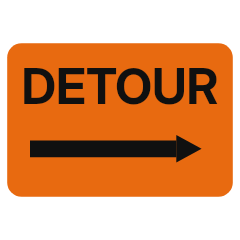
12. Which of these is true of the roadway a driver is being sent onto here?
Show answer
Answer D: Its own signs, signals and speed limits govern for the whole way around
The alternate route is an ordinary public road, so every control posted on it governs as usual; being sent that way grants no extra priority and no relief from the limits in force there.
-
13. You are turning right on a red light where that is permitted. What does the law require first?
Show answer
Answer B: A full stop, then yielding to traffic and pedestrians
A right turn on red is allowed only after stopping completely and giving way to everyone who has the green, including people in the crosswalk.
-
14. What should be adjusted on the motorcycle before carrying a passenger?
Show answer
Answer C: The suspension and the tire pressure, following the owner's manual
The extra weight compresses the suspension and loads the tires, so both should be set to the values the manufacturer specifies for riding with a passenger.
-
15. A sign at the signal reads LEFT TURN ON GREEN ARROW ONLY. The ball turns green but no arrow appears. What may you do?
Show answer
Answer C: Wait, because your turn is allowed only while the arrow is showing
The sign removes the permissive turn, so the left is legal only during the green arrow and you must wait behind the line until it appears.
-
16. You are driving through a neighborhood where several children are riding bicycles. What should you do?
Show answer
Answer C: Slow down and expect sudden, unpredictable moves
Young riders lack the judgment and the mirror habits of adults and may swerve or cross without looking, so lower speed is your only reliable margin.
-
17. You must stop for a train at a highway-rail crossing. Where should you stop?
Show answer
Answer B: Behind the stop line, gate or signal and well clear of the nearest rail
Stop behind the stop line, gate or flashing-light signal and well clear of the nearest rail, because a train overhangs its track by several feet on each side.
-
18. A vehicle ahead of you displays a reflective orange triangle on its rear. What does that emblem tell you?
Show answer
Answer B: The vehicle is built to travel at 25 mph or less
The orange triangle is the slow moving vehicle emblem used on farm and construction equipment designed for 25 mph or less, warning you that you are closing on it much faster than it appears.
-
19. You reach an intersection showing a steady red light, and a stop line is painted across your lane. Where must you bring the vehicle to a complete stop?
Show answer
Answer C: Before the stop line
A steady red requires a complete stop before the marked stop line. Where there is no stop line you stop before the crosswalk, and where there is neither, before entering the intersection.
-
20. Which of these does NOT affect how fast alcohol reaches the bloodstream?
Show answer
Answer A: How confident the drinker feels
Food, the strength of the drinks and the speed of drinking all change how fast alcohol is absorbed, but a drinker's confidence changes nothing at all.
-
21. Why should the leader of a group signal turns and lane changes early?
Show answer
Answer D: So the message has time to reach the riders at the back of the group
An early signal gives the whole formation, including the riders far back in the line, time to see the change and prepare for it.
-
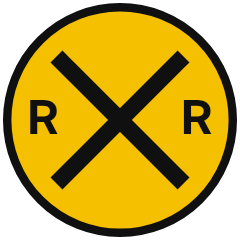
22. Where is this sign installed in relation to the hazard it announces?
Show answer
Answer A: Far enough before the hazard that a driver can slow down and stop short of it
This is an advance warning sign, placed on the approach so a driver has time to react before reaching a crossing that a curve or a crest may be hiding.
-
23. You are in the middle of an intersection when you hear a siren and see an emergency vehicle approaching. What should you do?
Show answer
Answer A: Keep going, clear the intersection, then pull to the right and stop
Stopping inside an intersection blocks the emergency vehicle. Clear the intersection first, then pull over to the right and stop.
-
24. Which sequence describes a well-made turn?
Show answer
Answer A: Signal, move into the correct lane, slow down, check, then turn
Tell others first, take your position, lose the speed before the corner, take a final look, and only then steer through the turn.
-
25. The leader of a group wants to pull the whole group out from a side road into busy traffic. What should the leader do?
Show answer
Answer B: Wait for a gap long enough for every rider in the group to enter
A leader who takes a gap that only fits one machine leaves the rest of the group either stranded or tempted to pull out in front of traffic.