
North Carolina NCDMV Motorcycle Practice Test 14
- Questions25
- Correct to pass20
- Passing score80%
- Minimum age16 years
-
1. A left-turn bay opens ahead of the intersection with a solid white line beside it. Where should you enter the bay?
Show answer
Answer C: At the opening before the solid line begins
The solid line marks where lane changes are no longer intended, so you move into the turn bay at its opening rather than cutting across the line later.
-
2. What is the usual result of driving well above the flow of traffic on a typical trip?
Show answer
Answer B: Very little time saved, with much greater risk
Signals, traffic and short distances swallow the theoretical gain, while crash risk and crash severity both climb sharply with speed.
-
3. You are turning right onto a one-way street. Which lane of that street should you enter?
Show answer
Answer C: The lane closest to the right curb
Even though every lane on a one-way street runs your way, a right turn must end in the lane nearest the right curb; you may change lanes afterwards when it is safe.
-
4. Why is being predictable an important part of driving safely?
Show answer
Answer A: Because other road users are able to plan around what you are doing
Other drivers make their decisions from what they expect you to do, so surprises are what produce collisions.
-
5. What is wrong with slowing to a crawl at a stop sign and then rolling on through?
Show answer
Answer C: It is not a stop, and you may miss a pedestrian or cross traffic
A rolling stop is a violation and it also cuts short the moment you need in order to look carefully in each direction before entering.
-
6. Why is it dangerous to make a left turn from the second lane from the center?
Show answer
Answer C: Because a driver in the lane beside you is turning into the same space
Drivers in the proper turn lane are entitled to that space, and turning across them puts two vehicles into one path through the intersection.
-
7. Why is it better for a passenger to hold the rider's waist or hips rather than the rider's shoulders?
Show answer
Answer A: Weight held low is less likely to disturb the rider's steering
Pulling on the shoulders feeds the passenger's movement straight into the rider's arms and handlebars, while a grip at the waist keeps that weight low and central.
-
8. In the code that governs pavement markings, what does a double line stand for?
Show answer
Answer B: A maximum restriction
The marking code is consistent: a double line means the strongest restriction, a solid line discourages or forbids crossing, and a broken line is permissive.
-
9. Why do safety agencies put head protection first among riding gear?
Show answer
Answer A: Because head injuries are the leading cause of death in motorcycle crashes
Head injury is the most common cause of death in motorcycle crashes, which is why a certified helmet is the single most important piece of gear.
-
10. You are turning right where a paved trail crosses the road just past the corner. What should you look for?
Show answer
Answer B: Cyclists and walkers arriving from either direction on the trail
A shared use path carries two-way traffic on foot and on bicycles, so scan both directions along the trail before crossing it.
-
11. How should a long trip be broken up to keep the driver alert?
Show answer
Answer D: Stop for a break every couple of hours and share out the driving
Regular breaks and a change of driver are the only reliable answers to fatigue; caffeine only postpones it.
-
12. You are approaching a horse and rider on a country road. What about your horn?
Show answer
Answer C: Do not sound it at all, because the noise can frighten the animal
A startled horse is dangerous to its rider and to you, so pass wide and slow and leave the horn alone.
-
13. Traffic is entering the freeway from a ramp ahead of you and you are in the right lane. What should you do?
Show answer
Answer C: Move to another lane if it is safe, or adjust your speed to make room
Merging drivers may have little room to adjust. Helping them in by changing lanes or easing your speed prevents conflicts even though they must legally yield to you.
-
14. Where does North Carolina's ban on using a phone for email or text messages apply?
Show answer
Answer D: On public streets and highways and in public vehicular areas
North Carolina makes it unlawful to use a cell phone for electronic mail or text messages while operating a vehicle on a public street or highway or public vehicular area.
-
15. How does the crown of a road affect a turn made on it?
Show answer
Answer C: Turning toward the low side leaves less ground clearance for leaning
Leaning down the slope of the crown adds the slope to the lean angle, so the footrests and other parts reach the pavement sooner than they otherwise would.
-
16. Why is following distance measured in seconds rather than in car lengths?
Show answer
Answer A: Because a time gap automatically grows with speed, while a fixed number of car lengths does not
A gap counted in seconds keeps the same margin of reaction time at any speed, whereas a fixed number of car lengths becomes far too small as speed rises.
-
17. A set of reversible express lanes is closed off with gates and signs while it runs the other way. What must you never do?
Show answer
Answer C: Enter past a closed gate or a sign showing the lanes are closed
When reversible lanes are closed they may already be carrying traffic in the opposite direction, so entering past a gate can put you head-on into that traffic.
-
18. You are approaching a refuse collection truck working along your street. What should you expect?
Show answer
Answer D: Workers stepping into the road around the truck
Collection crews move constantly between the truck and the curb, often from where you cannot see them, so slow right down and pass only when the whole area is clear.
-
19. You want to turn right at a steady red light and no sign prohibits the turn. What is required?
Show answer
Answer B: Come to a complete stop, then yield to traffic and pedestrians before turning
A right turn on a steady red is permitted only after a complete stop and only after yielding to cross traffic and to pedestrians, and a posted sign can prohibit it entirely.
-
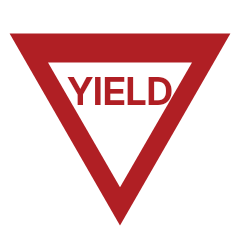
20. A driver passes this sign on an entrance ramp while merging onto a freeway. Who has priority?
Show answer
Answer B: The traffic already traveling on the freeway
The sign places the duty on the entering driver, who must adjust speed and fit into a gap without forcing through traffic to brake or swerve.
-
21. At an intersection the signal flashes red toward you and flashes yellow toward the cross street. Who must yield?
Show answer
Answer D: You must, because the flashing red faces your road
A flashing red means stop and yield like a stop sign, while a flashing yellow lets the other road proceed with caution.
-
22. Which sign tells you that the vehicles ahead are part of a funeral procession?
Show answer
Answer C: Headlights burning in daylight, with small flags or markers on the vehicles
Processions are normally identified by daytime headlights, hazard lights and flags or windshield markers, not by emergency lights or sirens.
-
23. You are descending a long steep grade with a loaded truck close behind you. What should you do?
Show answer
Answer A: Hold a steady speed and let it pass when it can
Gravity pushes a loaded truck downhill and it cannot slow quickly, so give it a predictable speed and room to get by rather than braking in front of it.
-
24. Compared with dry pavement, how much room does a vehicle need to stop on packed snow?
Show answer
Answer D: Several times as much
Grip on packed snow is a fraction of that on dry pavement, so stopping distance grows several times over. Antilock brakes help you steer, not stop shorter.
-
25. On a highway with mileage-based exit numbering, you have just passed exit 42 and are looking for exit 55. About how far is it?
Show answer
Answer B: Thirteen miles
With mileage-based numbering each exit takes the number of the nearest milepost, so subtracting one exit number from another gives the distance in miles.