
North Carolina NCDMV Permit Practice Test 45
- Questions25
- Correct to pass20
- Passing score80%
- Minimum age15 years
-
1. How does a NO OUTLET sign differ from a DEAD END sign?
Show answer
Answer B: It warns that a whole group of streets has no way out
No Outlet is posted where the road leads into a network of streets from which there is no through route, while Dead End refers to the single street itself.
-
2. Which of these is an early warning that you are too tired to keep driving?
Show answer
Answer C: Not remembering the last few miles you drove
Memory gaps, repeated yawning, heavy eyelids and drifting are the body signaling that sleep is winning, and they mean stop rather than push on.
-
3. A school crossing guard has returned to the curb but two children are still walking across the road. When may you go?
Show answer
Answer C: Only after the children have reached the far sidewalk
The guard leaving the road does not end your duty; you stay stopped until every child is clear of the roadway.
-
4. You have loaded the trunk heavily. Why might oncoming drivers flash their lights at you at night?
Show answer
Answer D: The rear sits lower, so your headlights point higher and dazzle them
Weight in the back tips the vehicle nose up and lifts the beam pattern, so low beams shine into the eyes of drivers coming the other way.
-
5. How long should a young child ride in a rear-facing child seat?
Show answer
Answer D: Until the child outgrows the height or the weight limit of the seat
Rear facing is the safest position and should be kept until the child reaches the top height or weight allowed by the seat.
-
6. Your vehicle has broken down at night on a rural road and your phone has no signal. What is the safest thing to do?
Show answer
Answer C: Stay with the vehicle, keep the hazard lights on and wait for help
A lit vehicle is far easier to find than a person walking in the dark, and running the engine while you sleep risks carbon monoxide.
-
7. A rear tire blows out on the highway. How does the vehicle usually behave?
Show answer
Answer C: The back end weaves or fishtails from side to side
A rear failure shows up as the tail wandering rather than a pull on the steering, so hold the wheel straight and let the speed drop gradually.
-
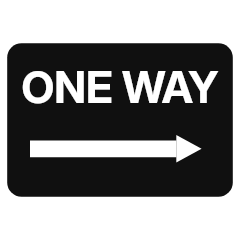
8. A driver on the street this sign governs is preparing to turn left at the next corner. Which lane should the vehicle be in beforehand?
Show answer
Answer A: The lane closest to the left curb
All the traffic here runs the same way, so nothing is coming toward the driver and the turn is taken from the extreme left lane rather than from beside the middle of the roadway.
-
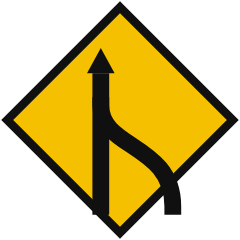
9. What is the safest way to deal with the situation this sign announces?
Show answer
Answer B: Match the speed of the other traffic stream and open a gap so vehicles can blend without hard braking
Blending works when speeds are matched and gaps are opened, so nobody has to brake hard or swerve where the two streams come together.
-
10. What is the purpose of a wide solid white line painted straight across your lane on the approach to an intersection?
Show answer
Answer C: It shows the point where a required stop must be made
A stop line indicates the point at which the stop required by a signal or a stop sign is to be made, ahead of the crosswalk and the intersection.
-
11. You began a turn from the wrong lane and are already inside the intersection. What should you not do?
Show answer
Answer A: Reverse in order to get back into the correct lane
Backing up in an intersection puts you into the path of traffic that cannot expect it; finish the movement and fix your position afterwards.
-
12. What is the safest way to pass a bicyclist on a road with two lanes going your way?
Show answer
Answer D: Change lanes completely, as you would for a car
A bicycle is entitled to the room a vehicle needs, and moving into the next lane gives the rider space to swerve around a drain or a pothole.
-
13. You are making a U-turn at a signal on a green left arrow. Who must you still watch for?
Show answer
Answer D: People in the crosswalk you will cross as you come around
Even a protected arrow does not clear the crosswalk, and a U-turn sweeps across a crosswalk that pedestrians may already be using.
-
14. The trailer you are towing begins to sway from side to side at highway speed. What should you do?
Show answer
Answer D: Ease off the accelerator, hold the wheel steady and let the speed drop
Sway grows with speed and with sudden inputs. Reducing speed gently while keeping the steering steady lets the trailer settle behind you.
-
15. Traffic is heavy and crawling where a sign warns that your lane ends and two lanes must become one. What is the best practice?
Show answer
Answer C: Use the lane to the end, then take turns merging one by one
In stop-and-go traffic the zipper merge, using both lanes up to the merge point and then alternating, keeps the queue shorter and traffic moving; in free-flowing traffic move over as soon as it is safe.
-
16. How should a pregnant driver or passenger wear a seat belt?
Show answer
Answer A: Lap belt below the belly across the hips, shoulder belt across the chest
A properly worn belt protects both mother and baby. The lap portion goes low under the belly, snug across the hip bones, and the shoulder belt crosses between the breasts.
-
17. You are the second vehicle waiting to turn left on a green ball. Where should you wait?
Show answer
Answer A: Behind the stop line, until the first vehicle has actually turned
Only the lead vehicle should move into the intersection to wait; a second vehicle inside it is likely to be stranded there when the light changes.
-
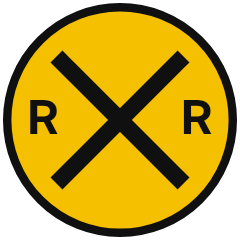
18. This sign leads to a crossing that has no gates and no flashing lights. What does that mean for the driver?
Show answer
Answer D: Nothing will warn of an approaching train, so the driver must check the tracks personally
At a passive crossing there is no active device to announce a train, so the whole judgment rests on the driver, who must approach slowly enough to stop after looking along the track.
-
19. You have turned onto a ramp at night and your headlights pick out large white arrows painted on the pavement pointing straight back at you. What do they mean?
Show answer
Answer C: You are traveling against the flow and must turn back
Wrong-way arrows are laid so that a driver going the correct way never sees them head on, so an arrow pointing at you means you are on the ramp backwards.
-
20. You are clear of the tracks after your vehicle stalled on a crossing. Whom should you contact?
Show answer
Answer C: The emergency number posted on the blue sign at the crossing, or 911
Grade crossings carry an emergency notification sign with a railroad phone number and a crossing identification number so that approaching trains can be stopped, and 911 works if that sign is not visible.
-
21. How far ahead should you normally be looking while driving?
Show answer
Answer D: About 12 to 15 seconds of travel ahead
Looking that far ahead, roughly a block in town and much farther on a highway, gives you time to see a problem developing and adjust before it becomes an emergency.
-
22. You are passing a crash on the other side of a divided highway. What should you do?
Show answer
Answer D: Keep your eyes on your own lane and the traffic around you
Staring at a crash scene, often called rubbernecking, causes sudden slowing and secondary collisions. Your attention belongs on the traffic in front of you.
-
23. You are using the parking brake to slow a vehicle whose brakes have failed. How should you apply it?
Show answer
Answer D: Gradually, holding the release so you can let it off if the rear slides
The parking brake works on two wheels only, so applying it hard can lock them and spin the vehicle. Keep the release held so you can back it off instantly.
-
24. A raised area crosses the roadway and carries a series of white markings on its face. What are those markings for?
Show answer
Answer A: To make the hump visible so drivers slow for it
Speed hump markings warn drivers that the pavement rises, which matters most at night or when the hump is in shadow.
-
25. What do flashing yellow lights on a school bus mean?
Show answer
Answer A: The bus is about to stop to load or unload, so prepare to stop
The amber lights are the warning phase that comes before the red lights and the stop arm, so drivers should slow down and get ready to stop.