
North Carolina NCDMV Permit Practice Test 24
- Questions25
- Correct to pass20
- Passing score80%
- Minimum age15 years
-
1. Your steering suddenly feels light and unresponsive as you drive through standing water. What should you do first?
Show answer
Answer A: Ease off the accelerator and keep the steering wheel pointed straight
Those symptoms mean the tires are riding on a film of water, and gently lifting off the accelerator lets them settle back onto the pavement. Hard braking or sudden steering while hydroplaning can start a skid.
-
2. What belongs in a basic emergency kit carried in a car?
Show answer
Answer D: A flashlight, a first aid kit, jumper cables and some warning devices
A useful kit lets you see, be seen, treat an injury and restart the vehicle; carrying loose gasoline is a fire risk.
-
3. How much clearance does North Carolina law require when passing a vehicle on its left?
Show answer
Answer D: At least two feet
North Carolina requires the passing driver to pass at least two feet to the left of the vehicle being passed, and the handbook repeats the same figure for passing a moped.
-
4. A driver on a hands free call looks straight at a red light and drives through it. What best explains this?
Show answer
Answer B: The eyes saw it but the brain did not process it
Attention, not eyesight, decides what a driver actually sees, and a loaded mind can leave a driver looking straight at a hazard without registering it.
-
5. An orange sign reading END ROAD WORK is posted beside the highway. What does it mark?
Show answer
Answer C: The point where the work zone restrictions stop
The sign is installed at the downstream end of the temporary traffic control zone to tell drivers that normal conditions apply again.
-
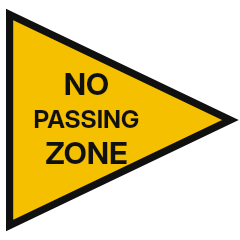
6. A driver is thinking about overtaking a slower vehicle and sees this sign a short distance ahead. What does it mean for that pass?
Show answer
Answer B: The pass must be finished before the restricted section begins
The sign marks the start of a section where passing is prohibited, so a driver may not be on the left side of the road beyond it; any pass has to be completed before that point or not started at all.
-
7. A farm implement ahead of you on a two-lane road is wider than its own lane. What should you do?
Show answer
Answer D: Hang back until you can see past it and pass only with a clear road
Wide equipment hides the road ahead and may extend farther across the center line than it appears, so the pass needs more room and a much better view.
-
8. You come upon a crash that has just happened and decide to help. Where should you stop your vehicle?
Show answer
Answer A: Well beyond the scene, completely off the road, with the hazard lights on
Stopping past the crash and off the pavement keeps you from becoming another victim and leaves the approach clear for emergency vehicles.
-
9. In which situation should you increase your usual following distance?
Show answer
Answer B: On wet roads, at night, in fog, when towing a trailer, or when following a motorcycle
Reduced traction, reduced visibility, a heavier load and a vehicle that can stop faster than yours all require extra space to keep the same margin of safety.
-
10. You are very angry after an argument and about to drive. What should you know?
Show answer
Answer A: Strong emotions can impair judgment and attention much like alcohol
Anger, grief and stress pull attention inward and encourage risk taking. Give yourself time to settle down before getting behind the wheel.
-
11. Your light turns green, but a vehicle from the cross street is still finishing a turn inside the intersection. What should you do?
Show answer
Answer B: Wait until that vehicle has cleared the intersection
A green indication lets you proceed only after yielding to pedestrians in the crosswalk and to vehicles already lawfully within the intersection.
-
12. You receive a phone call that you feel you must answer while driving. What is the safest way to take it?
Show answer
Answer D: Pull off the road, stop in a safe place and then answer
No call is worth a crash. Stopping in a safe location removes the distraction completely, while every other option divides your attention.
-
13. Where should the lap part of the seat belt sit?
Show answer
Answer C: Low and snug across the hips, touching the tops of both of the thighs
The hip bones can take crash forces, but the abdomen cannot, so the lap belt goes low and tight across the hips.
-
14. What is the safe way to carry a dog in a car?
Show answer
Answer C: In a secured crate, or in a harness attached to a seat belt anchor
An unrestrained animal distracts the driver and becomes a heavy projectile in a crash, so it should be crated or harnessed.
-
15. A yellow sign reading DEAD END is posted at the entrance to a street. What does it mean?
Show answer
Answer D: The street ends and there is no way through
A dead end street stops at its far end, so a driver who enters must come back out the same way.
-
16. A yellow diamond shows a horse with a rider. Besides slowing down, what else should a driver do?
Show answer
Answer C: Avoid using the horn or revving the engine
The equestrian crossing sign warns of horses on or across the road, and a sudden noise can startle an animal into the traffic lane.
-
17. A yellow diamond showing a bicycle is posted on a rural road. What should a driver expect?
Show answer
Answer A: Bicyclists crossing or riding along the roadway there
The bicycle warning sign is used where a bikeway crosses the road or where riders are likely to be in the traffic lanes, so drivers should look carefully and pass wide.
-
18. How long must a North Carolina Level One permit be held before applying for a Limited Provisional License?
Show answer
Answer C: Nine months
North Carolina requires the Level One Limited Learner Permit to be held for nine months before an application for the Level Two Limited Provisional License.
-
19. Someone has stepped into a marked crosswalk in the middle of a block ahead of you. What should you do?
Show answer
Answer A: Slow down, stop before the markings and let the person cross the street
A marked mid-block crosswalk carries the same duty as one at a corner: give way to the person crossing, stopping if that is what letting them cross safely takes.
-
20. A North Carolina Level Two holder drives unsupervised with a non-household passenger under 21 aboard. What applies to under-21 household members?
Show answer
Answer B: They may not be in the vehicle at the same time
North Carolina bars under-21 household members from riding while an under-21 non-household passenger is present and a Level Two holder is driving unsupervised.
-
21. An overhead lane-use control signal shows a steady red X above your lane. What does it mean?
Show answer
Answer B: You may not use that lane and must move out of it
A steady red X means the lane below it is closed to you, while a steady yellow X is the warning to prepare to vacate the lane and a downward green arrow means the lane is open.
-
22. Your light turns green, but a vehicle is still in the middle of the intersection. What should you do?
Show answer
Answer D: Wait until the intersection is clear before you move ahead
A green light means go only when the way is clear. Drivers already inside the intersection must be allowed to finish crossing.
-
23. What revocation does North Carolina impose when a driver is convicted of speeding and of reckless driving arising from the same occasion?
Show answer
Answer A: 60 days
North Carolina takes the driving privilege for 60 days when a driver is convicted of speeding plus reckless driving on the same occasion.
-
24. You have begun to move into the next lane when the gap you were aiming for closes. What is the safest action?
Show answer
Answer C: Return to your own lane, cancel the signal and wait for a better gap
An unfinished lane change leaves you in a space that no longer exists, and the lane you came from is still yours.
-
25. A pedestrian with a white cane draws the cane back and steps away from the curb as you approach. What does that usually mean?
Show answer
Answer B: They are signaling you to go ahead and drive on
Pulling the cane in and stepping back from the curb is the customary way a blind pedestrian tells drivers to proceed.